Exam preparation
Practise for the exam, not for the problem set.
Every question is written for one course in one programme: its syllabus, its notation and terminology, and the methods it accepts.
No account needed to look around.
Work it typed, or photograph it off paper, and it is checked the moment you submit.
The instrument
A problem set and an exam ask you different things.
Course work is built to teach you the week's material. It is not built for the conditions you are marked under.
- The clock
- A problem setAs long as you like.
- A timed paperOne sitting.
- How many questions
- A problem setWork a problem through.
- A timed paperAbout twenty of them, drawn from the whole course.
- When you find out
- A problem setWhen the solutions are posted.
- A timed paperNothing about your answers is revealed until you hand it in.
Memoza gives you the second as well as the first, and the second is what it is built around.
Four things decide the practice, and each one comes with what it does not do.
Written for one programme: its syllabus, its notation and terminology, the methods it accepts, and the assessment structure the programme states.
Read from your own past papers, on a course you build: Memoza reads what they say about the exam itself, you confirm or correct each fact before it is used, and a catalogue course carries no such profile.
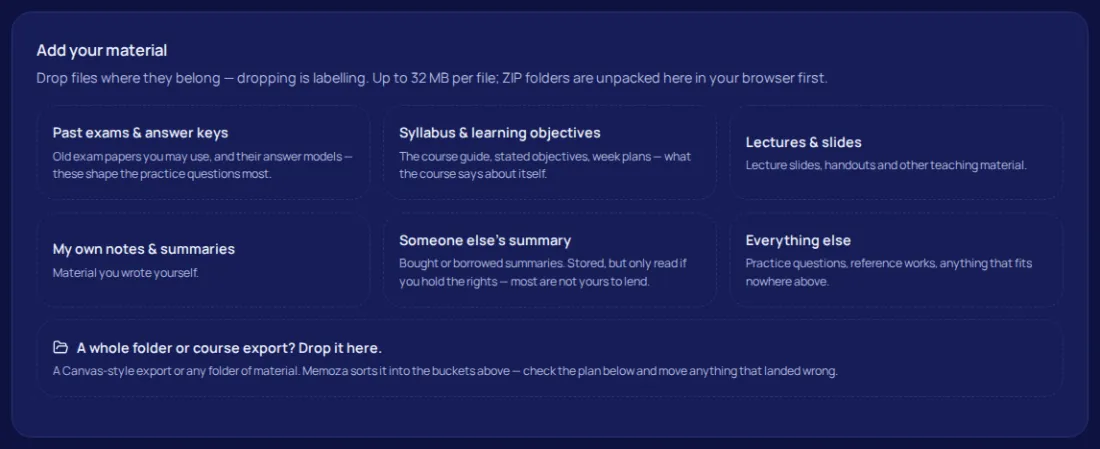
Sat under a clock: a course can be sat as a timed paper drawn from its own question bank, on courses whose answers a paper can carry, which today means mathematics, physics and computer science courses, and where the course states no length of its own that sitting runs two hours.
Marks awarded the way the rubric awards them: the rubric your marks come from is written for that question by the people who built the course, not copied from a real marking scheme.
Two roads
Two ways to get your course.
One is written for your programme, one you build from your own material, and the practice is the same either way.
Written for your programme
One course in one programme, and you can look around with no account.
Courses appear in the catalogue as they are built, with the students and teachers who bring the material.
Built from your own material
It needs an invited account, because the course belongs to the person who builds it.
Progress and the week
You always know what to drill next.
Your course drawn as a sky, one next thing to practise with the reason it was picked, and a week that fits the week you actually have.
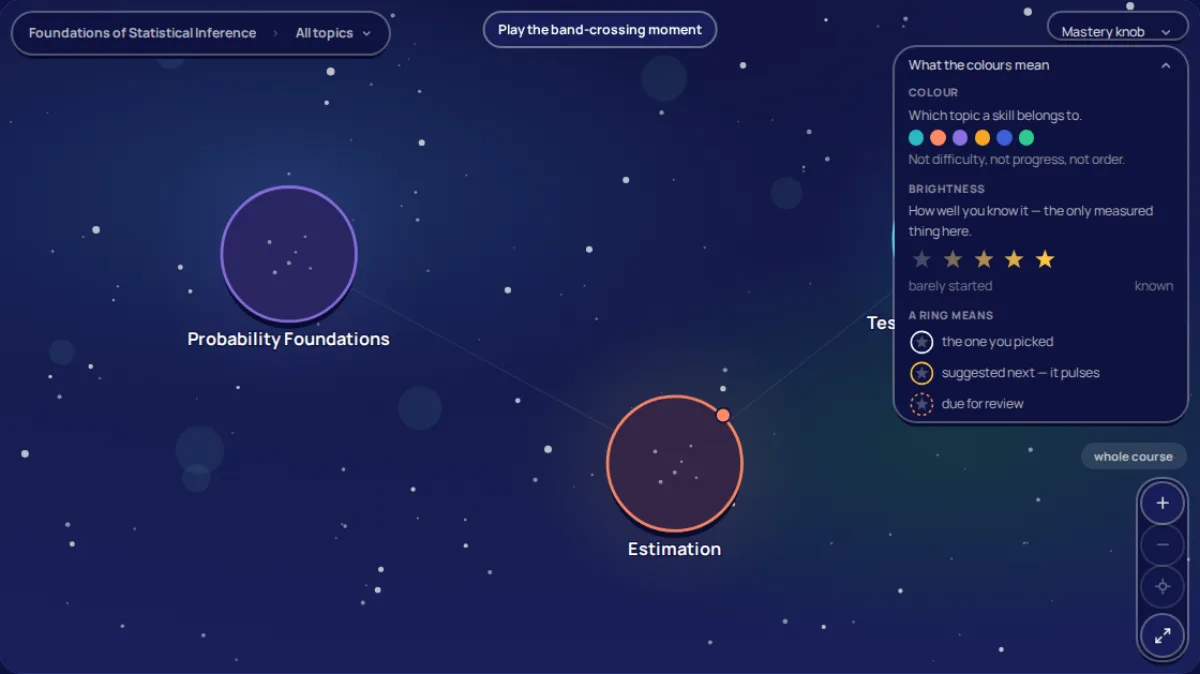
A star’s brightness is how well you have shown you know that skill, and it moves only from questions you have answered, so nothing is lit before you practise.
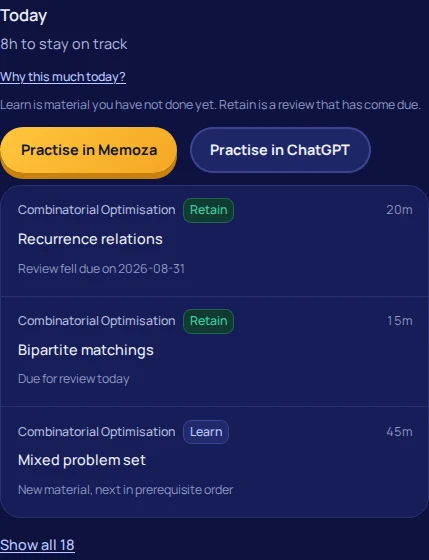
You say what the week holds, and Memoza does the arithmetic and leaves the judgement to you.
How it works
Solve it the way you will solve it in the exam.
Useful, and not the reason to be here.
Type it, or work it on paper
A calculation you type is checked symbolically against a pre-validated solution, never by a model. A written proof is different: an AI model judges it against the marking rubric, and the result says so. Or work it on paper the way you would in the exam and photograph the page; multiple-choice and ordering questions are answered on screen.
The camera only reads
The reading appears in the answer box for you to check and correct, and only what you confirm is marked.
See where the marks went
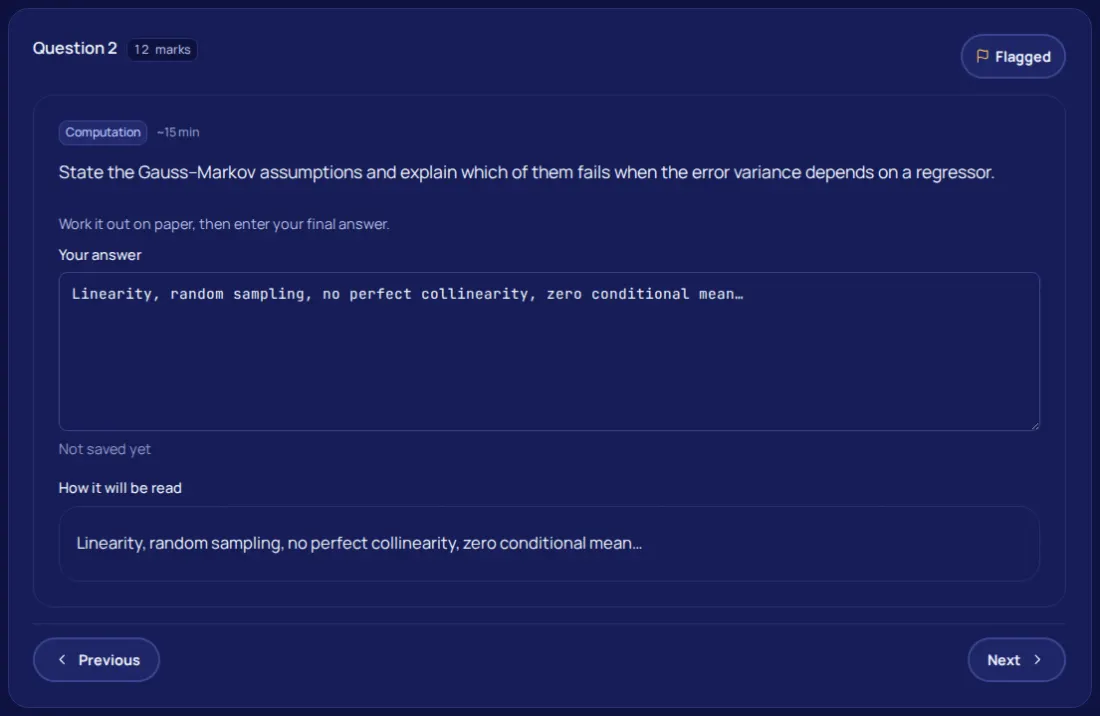
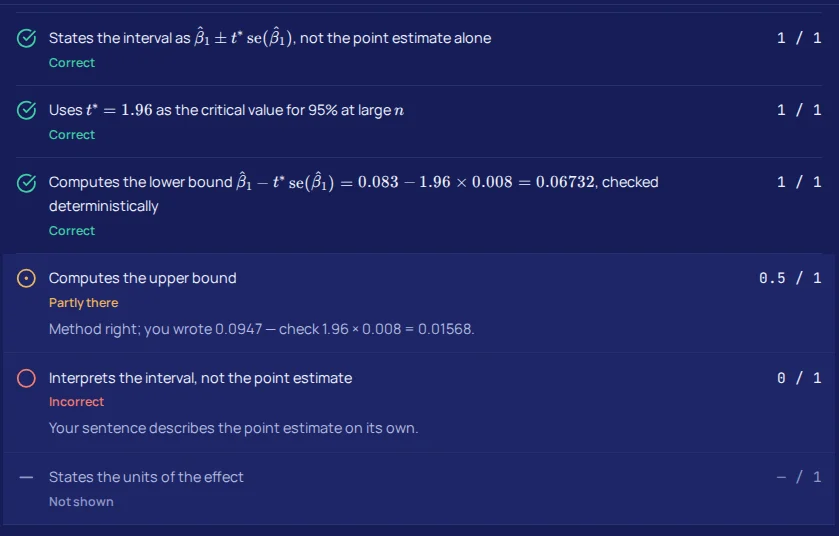
Where you showed your working and the question’s rubric has values for its steps, the result itemises where the marks went, and a step nobody looked at is left blank rather than scored zero.
Let X be a discrete random variable with:
Calculate
A worked example, checked in your browser against this question’s published answer. It shows the shape of the feedback — a verdict, and the rubric the points come from — not the marking engine itself.
Straight answers
What Memoza is, and what it is not.
Statements you can hold us to.
Memoza is an adaptive, course-specific learning and exam-preparation platform. It does not replace lectures, textbooks or studying itself. It replaces ineffective practice, such as passive rereading, random question selection and last-minute cramming.
We don't invent numbers — and we don't invent praise. There are no testimonials here until real students have said real things, and no outcome statistics until we have real cohort data.
Stop guessing how to study.
Memoza handles the learning process around you.
Or try the demo first, with no account.
Or read first: Breadth first, depth first: how to order a syllabus·Forced and unforced: how to classify your exam mistakes